A CLOSER LOOK · SPOILER-LIGHT VIEWING GUIDE
The General
A chase you can read with your eyes.
If silent comedy feels remote, start with a simple pleasure: understanding exactly what a performer is trying to do, seeing the obstacle, and anticipating the next problem. The General turns a locomotive pursuit into a sustained exercise in visual problem-solving. Watch the whole frame, not just the face at its center.
Find this film & play ↗Opens this title in the existing Melverse catalog.
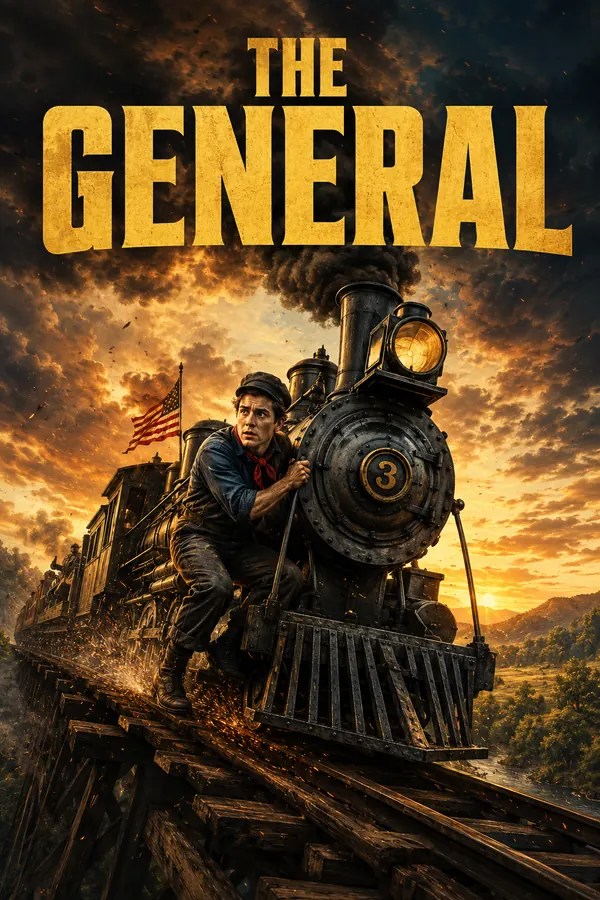
Before you press play
The Library of Congress catalogs The General as a 1926 film directed and written by Buster Keaton and Clyde Bruckman, with Keaton also starring. Some film references use 1927 for its wider release. Its protagonist is a Confederate railway engineer during the American Civil War. That chosen perspective is part of the film’s framing, not a neutral account of the conflict.
Find the problem before the solution
Before a gag resolves, identify three things: the direction of travel, the object that needs moving, and the limited time available. The clearer those relationships become, the more satisfying a tiny adjustment can feel. You can enjoy a scene twice by asking whether its first image already contains the information needed to predict the result.
Give the long shot time
A close-up tells you where to look. A wider view can let you discover the joke yourself. Let your attention travel between the performer, the machinery, and the surrounding track. A movement at the edge of the frame may change the situation before the character reacts. The pleasure comes from sharing the space and sometimes knowing a little more than the person navigating it.
Watch repetition become variation
A chase creates opportunities for locations and obstacles to recur. When something familiar returns, compare who now has the advantage and what practical detail has changed. Repetition can be a form of storytelling rather than filler: it gives you a memory against which the next action makes sense. Try keeping one object in mind across a sequence and see how often its purpose changes.
MAKE YOUR OWN NOTES
Three questions after watching
- Which gag is clearest without any explanatory title card?
- When do you understand a danger before the character does?
- How does the scale of the machinery affect the comedy?
There is no answer key. Use a specific image, action or exchange to support your own reading.
Make it a double feature
Follow a chase built around continuous space with Sherlock Jr., where editing can replace the world around a performer.
Next: Sherlock Jr. →Background & further reading
Library of Congress film record ↗
Linked historical references support the film background and may contain spoilers. The questions and viewing approach above are Melverse’s AI-assisted editorial material, not quotations from or endorsements by the linked institution. Read our approach or report a correction.